Blog · · 7 min read
Be Bored. It is not a bad thing
Meet Alan. It could just as well be Daisy, Rahul, Faiz, Maya, or you. It doesn’t matter. Alan likes to stay stimulated. That’s how his dopamine[1] works. Any time his dopamine levels go down, it makes him feel a bit uneasy. He wants or even needs the next distraction to feel engaged. He doesn’t like his mind being “dull” or “unoccupied”. Therefore, he uses any means possible to continue getting dopamine hits.
Being bored and letting yourself stay bored has become a rarity. I see people around me, including myself, finding themselves fighting boredom through any means necessary and staying stimulated.
Before we go further, let’s discuss what exactly dopamine is. In simple terms, it’s like a reward mechanism for your body. It makes you want to repeat pleasurable activities. In slightly more technical terms, it is a chemical messenger in your brain acting as a neurotransmitter[2] as well as a hormone.
Dopamine helps you get the motivation you need to accomplish tasks. It also plays a key role in maintaining attention and focus, as well as pleasure and anticipation. Imagine you are hungry and craving sushi. Dopamine helps create the motivation to go fetch sushi and depending on how much you liked it, your brain will remember it for the next time and whether you will seek it again.
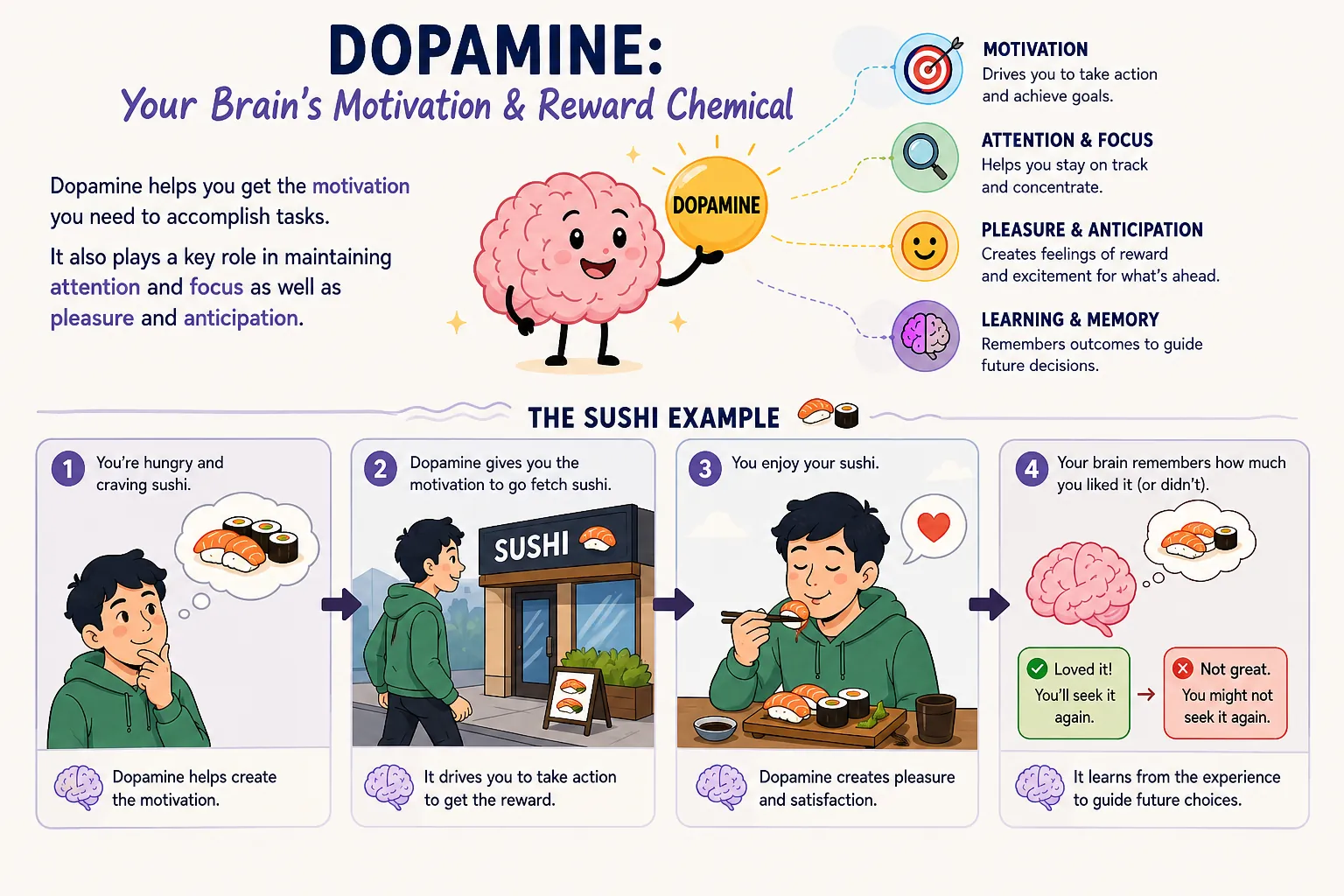
Dopamine is essential to the overall well being of human beings. A loss of dopamine producing neurons is closely linked to diseases like Parkinson’s disease[3], while a dysregulation of dopamine is linked to depression[4], ADHD[5], and other disorders.
Let’s bring our focus back to being bored. When you are bored, in overly simplistic terms, your brain isn’t getting much to chew on from the outside. Your brain sits there without being actively engaged in anything. This is where it starts craving rewards. It looks into the past activities that you have been engaged in and encourages you to re-do them. This can be as simple as picking up your phone and scrolling endlessly on TikTok or Instagram.
But why do you scroll through these social media apps? It is because of the anticipation of new and interesting things that keep you hooked and the feeling that if you scroll through a few more videos, you will find something even more entertaining and novel. “It will be worth it” is how the brain convinces you to keep scrolling for more. Other reasons can also include a reward mechanism where you get “rewarded” if someone “liked” your photo or “story” posted on Instagram or Facebook. To the brain, especially when you are “bored,” it is these anticipations and rewards that push you to continuously check your phone. To put it plainly, this is called dopamine addiction. Oh, and btw, this kind of endless scrolling has a name now - doomscrolling[6]. Similar dopamine addictions can also be linked to things like video games, binge watching TV, and eating disorders.
There is an important distinction to make here though. In the sushi example we talked about, once you ate it, the craving was gone for a while. This is not the case with doomscrolling where there is no end and you can swipe forever keeping you hooked.
But are “anticipation” and “wanting” something the same as enjoying it? Research says no[7]. In that work, Berridge and Robinson looked at rats whose dopamine had been artificially depleted or boosted. In both cases, dopamine had no bearing on how much the rats “liked” the sugar. In other words, while dopamine can make you “want” something, it doesn’t make you like or enjoy it more.
The topic of dopamine is rich with details and many books have been written on it. One that I have read and can recommend is “The Molecule of More” by Daniel Z. Lieberman and Michael E. Long[8]. But I want to talk a bit more about how being bored is important and why we shouldn’t run from it.
Boredom can be thought of as a period of low stimulation. These are the periods when your brain gets an opportunity to wander through things that you usually don’t. It helps you reflect on the past, the present, and the future. Think of it as creative time when new ideas can emerge that can hold your attention without needing external stimulation.
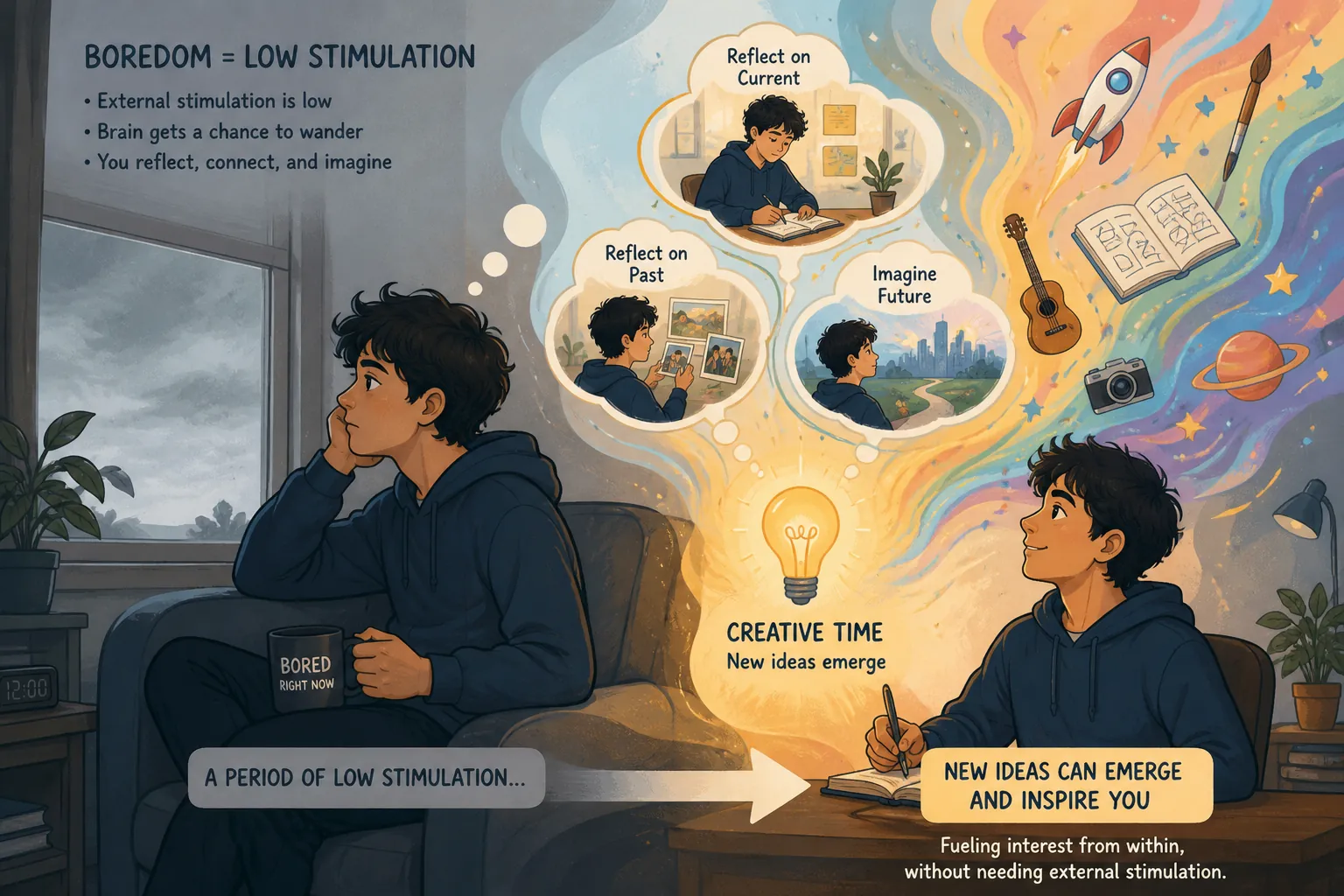
Take the example of Isaac Newton. His most famous ideas, including calculus and optics that eventually helped progress his theory of gravity, came during the time of the plague in the UK where his absence from a normal university environment gave him long stretches of uninterrupted time. And while we can argue that it wasn’t boredom but his genius that led to the creation of these ideas, it is reasonable to say that it helped not having TikTok around. Another example is that of Charles Darwin where it is said that he used to take daily walks along the Sandwalk reflecting on problems and ideas. Recent research[9] also shows that mind wandering can help with creative performance and help you solve a problem when you return after a low-stimulation break.
I am not saying that boredom alone will create great ideas. But what I am suggesting is that having periods of low stimulation where you let your brain wander can create insights that you might otherwise miss. Another side effect of not using your phone as much is that it gives you the ability to be more present in the non-digital world and make human connections. Maybe the person sitting next to you has an amazing story to tell that you will miss out on because you are busy watching a viral video on Instagram or YouTube. Or, maybe, and this is because I am a romantic, your soulmate is crossing the road and you will not even look at them because you are so busy looking down at your phone while crossing the lights. Being bored might also create opportunities for you to be more mindful of the people around you - your kids, parents, and friends. Think of how many opportunities have you lost to make a connection with your loved ones just because you didn’t look up from that damn phone or laptop.
Everything done in moderation is okay. I am not suggesting that you don’t use any social media or don’t scroll through videos. The difficult thing is knowing how to find that balance and, more importantly, maintain it. Unfortunately, I cannot answer that for you, and it is something you will need to reflect on…in your own “boring” time.
So, the next time you are bored, remind yourself - being bored is okay and you will be alright by not doing anything in that moment 🙂
Cheers to being bored!
References
- Juárez Olguín H, Calderón Guzmán D, Hernández García E, Barragán Mejía G. The Role of Dopamine and Its Dysfunction as a Consequence of Oxidative Stress. Oxid Med Cell Longev. 2016;2016:9730467. doi: 10.1155/2016/9730467. Epub 2015 Dec 6. PMID: 26770661; PMCID: PMC4684895.
- Kovács GL. The Endocrine Brain: Pathophysiological Role of Neuropeptide-Neurotransmitter Interactions. EJIFCC. 2004 Aug 31;15(3):107-112. PMID: 29988948; PMCID: PMC6034195.
- Mayo Clinic Staff. (2024, September 27). Parkinson's disease. Mayo Clinic. Mayo Clinic page
- Mayo Clinic Staff. (2026, September 1). Depression (major depressive disorder). Mayo Clinic. Mayo Clinic page
- National Institute of Mental Health. (2026, August). Attention-deficit/hyperactivity disorder (ADHD). National Institutes of Health. NIMH webpage
- Salamon, M. (2024, September 1). Doomscrolling dangers. Harvard Health Publishing. Harvard Health article
- Berridge, K. C., & Robinson, T. E. (2016). Liking, wanting, and the incentive-sensitization theory of addiction. American Psychologist, 71(8), 670–679. doi.org
- Lieberman, D. Z., & Long, M. E. (2018). The molecule of more: How a single chemical in your brain drives love, sex, and creativity—and will determine the fate of the human race. BenBella Books.
- Gable SL, Hopper EA, Schooler JW. When the Muses Strike: Creative Ideas of Physicists and Writers Routinely Occur During Mind Wandering. Psychol Sci. 2019 Mar;30(3):396-404. doi: 10.1177/0956797618820626. Epub 2019 Jan 17. PMID: 30653407.
Comments